
A patient sets a red, white, and blue card on the counter. You copy the number, hand the card back, and call the next person in line. That number is the Medicare Beneficiary Identifier, and it decides whether the visit gets paid. One wrong character and the eligibility check fails, the claim rejects, and someone on your team spends an afternoon untangling it.
It is worth knowing what the number actually is.
The number replaced something worse
Medicare cards used to carry the Health Insurance Claim Number, which was the beneficiary’s Social Security number with a letter stuck on the end. Every Medicare card in every wallet in the country displayed an SSN in full. New cards went out between April 2018 and April 2019, the transition period closed on December 31, 2019, and since January 1, 2020 claims have required the MBI. The old HICN is dead.
The MBI is 11 characters, randomly generated, and non-intelligent. Nothing in it encodes age, state, enrollment date, or anything else. A married couple who signed up the same week get two unrelated numbers.
It is still confidential. The MBI identifies a person’s Medicare coverage, so it belongs in the same protected category as the SSN it replaced.
The format has rules, and the rules are useful
Here is the part new staff never get told.
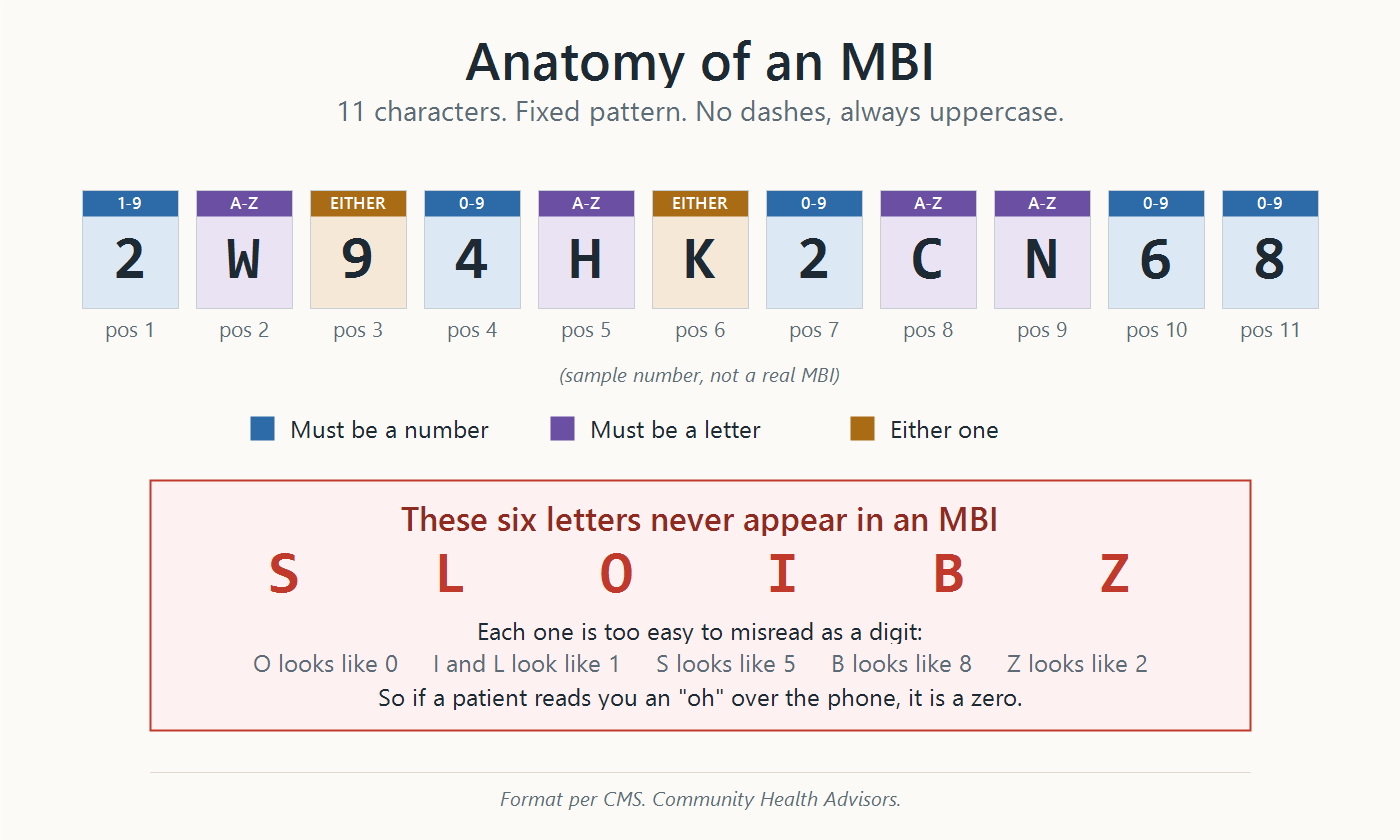
The MBI follows a fixed pattern. The first character is a number from 1 through 9. The second is a letter. The third can be either. The fourth is a number. The fifth is a letter. The sixth can be either. The seventh is a number. The eighth and ninth are letters. The tenth and eleventh are numbers. No dashes, and always uppercase.
Six letters never appear anywhere in an MBI: S, L, O, I, B, and Z. CMS left them out because each one is easy to mistake for a digit. O reads as zero, I and L read as one, S reads as five, B reads as eight, Z reads as two.
That exclusion list is a free error check, and most offices never use it. If a patient reads a number to you over the phone and says “oh,” it is a zero. Every time. If you have keyed a 1 into the eighth position, which has to be a letter, you have a typo and you know it before you submit anything. A card that looks like it shows BZ has faded ink or a bad scan, because that pairing cannot exist.
Patients lose cards, and that is normal
Cards go missing after a move. Cards sit in a drawer because the patient carries the Medicare Advantage plan card instead, and that card shows the plan’s member ID rather than the MBI. Front desks lose real time to this one.
There are three ways to recover the number. The patient can sign in at Medicare.gov, view the MBI, and print an official copy, which beats waiting on the mail. They can call 1-800-MEDICARE and request a replacement card. Or your office can look it up in your MAC’s secure provider portal, which requires the patient’s first name, last name, date of birth, and Social Security number. If the patient declines to give the SSN, that route closes and the Medicare.gov account is the answer.
The number can change
Most staff assume an MBI is permanent. It is not. CMS issues a new one when a beneficiary, an authorized representative, or CMS itself suspects the number has been compromised, and the old number stops working for claims on the effective date.
This stopped being a footnote in 2026. CMS reassigned roughly 1.3 million MBIs with an effective date of April 14, 2026, following data exposure at claims-processing vendors. Replacement cards went out in March. Providers were not told which of their patients were on the list.
The symptom is an eligibility response that makes no sense. An AAA 72 “invalid member ID,” or a portal that reports the beneficiary cannot be found for someone you treated in February. Before assuming the system is broken, assume the number changed.
What this means at the desk
Ask for the card at every visit instead of trusting what is in the chart. Scan both sides. Run eligibility ahead of the appointment rather than after the rejection. When a number fails, read it back against the position rules before you call anyone.
None of this is difficult. It is unglamorous, and it is the difference between a clean claim and a week of follow-up.
CMS keeps the official format reference here: Medicare Beneficiary Identifiers (MBIs).