
You send a claim to Medicare. Medicare does not process it.
A private company does, under contract to CMS, and which company depends entirely on where you provided the service. That company is your Medicare Administrative Contractor. It decides whether your claim pays, how quickly, and what happens when you disagree.
Most office staff learn this the hard way, usually while on hold with the wrong contractor.
What a MAC actually does
CMS writes the rules. MACs run the program.
Your MAC processes and pays Part A and Part B fee-for-service claims. It enrolls you in Medicare and maintains that enrollment. It runs the provider portal where you check eligibility and claim status. It handles the first level of appeal on a denied claim, which is the redetermination. It staffs the provider line. And it publishes local coverage determinations, which decide what is covered in your area when no national rule exists.
That last one surprises people. Your MAC has real authority over coverage, not just paperwork.
Twelve jurisdictions, seven companies
There are 12 A/B MAC jurisdictions covering all 50 states, the District of Columbia, and the territories. Seven companies hold them between them.
Noridian, Palmetto GBA, Novitas, WPS, and Wellpoint Federal each hold two. CGS and First Coast Service Options hold one each.
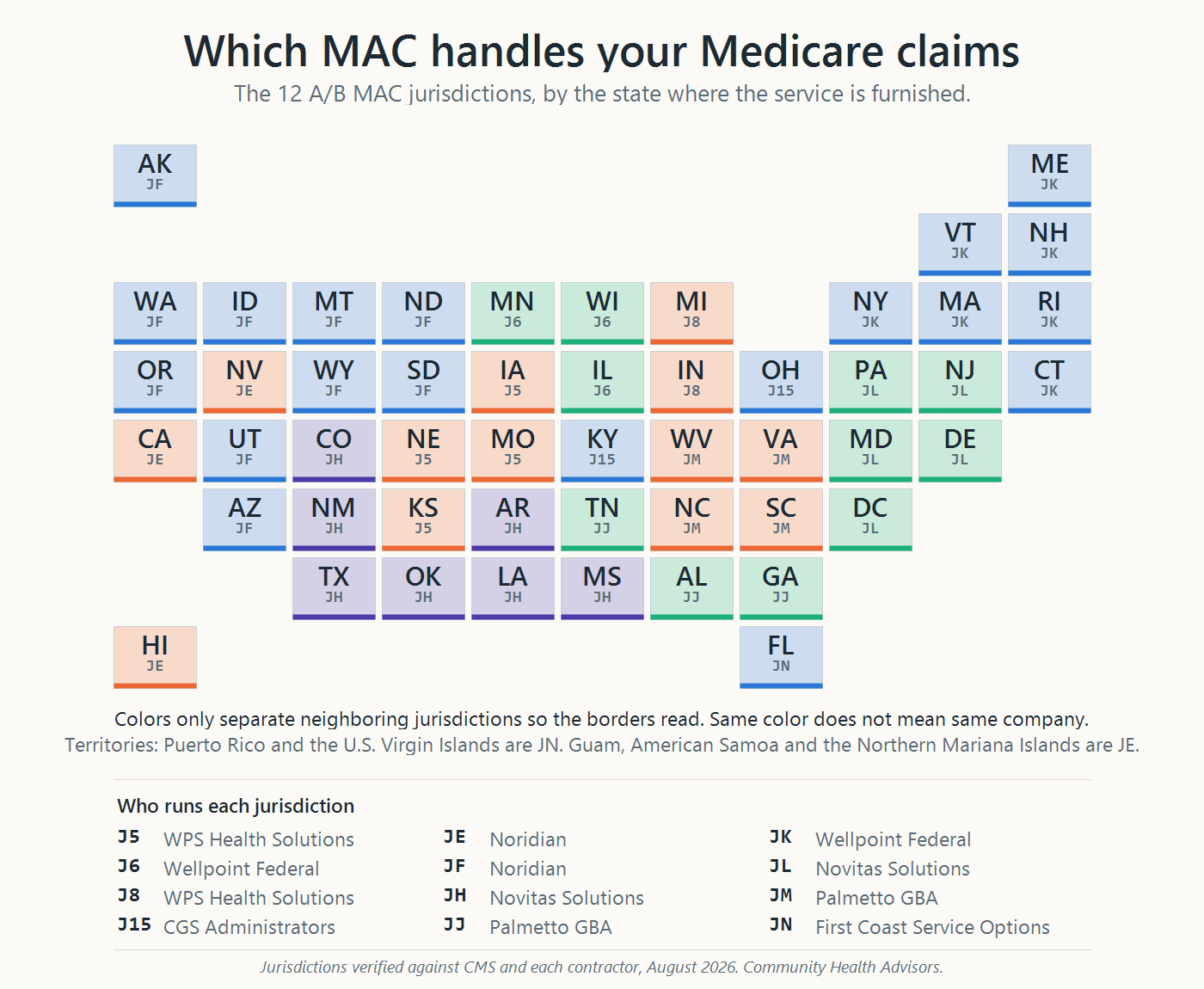
Assignment follows the state where the service was furnished. Not where your billing office sits, and not where the patient lives. A practice with locations in two states bills two MACs, which catches growing groups off guard more than anything else on this page. A physician who rounds at a hospital across a state line bills that state’s MAC for those visits, even though the practice itself never moved.
Durable medical equipment is separate. DMEPOS claims go to one of four DME MACs, carved into much larger regions: Noridian holds Jurisdictions A and D, CGS holds B and C. If you dispense equipment, you deal with a DME MAC on top of your A/B MAC, and they are separate operations even when the parent company is the same.
Your MAC can change without the map changing
MAC contracts are competitively bid, not permanent. CMS awards them for a base period with option years, then recompetes. The jurisdiction boundaries are stable. The company sitting on them is not guaranteed.
Incumbents usually win. Noridian kept Jurisdiction F in an award announced in August 2025, and Novitas kept Jurisdiction H. But usually is not always. When a jurisdiction changes hands, the handover brings new portal logins, fresh submitter setup, and a stretch of slower processing while the new contractor gets up to speed.
Worth knowing so it does not arrive as a surprise. Not worth thinking about month to month.
A tangent on why the names are a mess
You will notice the labels are inconsistent. Four jurisdictions are numbers, J5, J6, J8, and J15. The other eight are letters, JE through JN. Nothing about that is guessable from the outside.
The reason is historical. CMS originally laid out 15 numbered jurisdictions, then consolidated down to 12. The merged ones were given new letters. The four that were never merged kept their original numbers. Jurisdiction 1 became JE. Jurisdiction 11 became JM. J5, J6, J8, and J15 were left alone, so they still look like leftovers from the old scheme, because they are.
Nobody has tidied this up and nobody will. It is a small thing, but it explains why searching for “Jurisdiction 1” lands you on an archive page.
Why it matters at your desk
Three reasons, roughly in the order they bite.
The portal and the phone number are contractor-specific. There is no central Medicare provider line that can pull up your claim. Call the wrong MAC and you will be told, politely, to call someone else.
Local coverage determinations differ between jurisdictions. The same service, billed with the same code, can be covered in one state and denied in another because two contractors read the evidence differently. That deserves its own article and will get one.
Appeals start with your MAC. A redetermination request sent to CMS goes nowhere. It goes to the contractor that denied the claim in the first place.
The name on your portal changed this year
If your MAC was National Government Services, it is not anymore. NGS began operating as Wellpoint Federal on April 1, 2026, part of its integration under the Wellpoint brand. That covers Jurisdiction 6 and Jurisdiction K, which is most of the upper Midwest plus all of New England and New York.
Nothing operational changed. Payer IDs are the same. Claim submission is the same. EFT and remittance are the same. What changed is the name on the portal, the correspondence, and the education emails, and that is enough to make a new biller think they have landed in the wrong place.
Finding yours
Look up your state on the map, then go to that contractor’s site directly rather than through a search engine, since old MAC pages rank well and never quite die. Two examples of what you are looking for: Palmetto GBA runs Jurisdictions J and M, and Noridian runs E and F.
Then do two things. Register for the provider portal, because eligibility and claim status self-service will save more staff hours than anything else here. Eligibility checks, claim status, remittance copies, and appeal submission all live behind that login, and every one of them beats waiting on the phone. And get on your MAC’s email list. Coverage changes, system downtime, and new prior authorization requirements are announced there first, and sometimes only there.
Knowing your MAC is not deep expertise. It is closer to knowing the address on the envelope. But an office that does not know it is an office that spends its afternoons on hold with a contractor that was never going to be able to help.