
Helping Patients Who Have Both Medicare and Medicaid
Some patients hand you two cards at check-in: a red, white, and blue Medicare card and a state Medicaid card. These patients are “dual eligibles,” and they’re among the people who most need a community worker who understands how their coverage fits together. About 12 million Americans qualify for both programs. Many of them don’t fully understand what they’re entitled to, and a fair number are leaving benefits on the table because no one has explained them.
Here’s the short version of how the two programs relate. Medicare pays first. Medicaid pays second, picking up costs Medicare leaves behind: premiums, deductibles, coinsurance, and services Medicare doesn’t cover at all, like long-term care and, in most states, dental and transportation. For the patient, the practical effect is that out-of-pocket costs shrink or disappear.
The two tiers of dual eligibility
Not every dual eligible gets the same help, and the distinction matters when you’re setting expectations.
Full duals qualify for complete Medicaid benefits on top of Medicare. They get the widest coverage, including long-term services and supports.
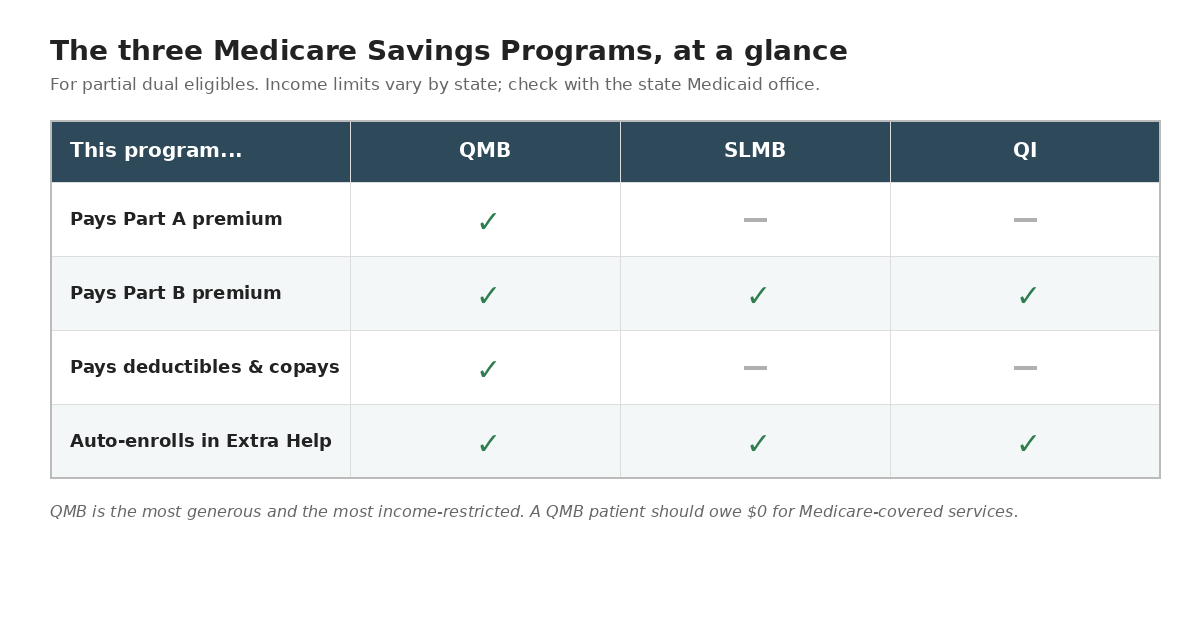
Partial duals qualify only through a Medicare Savings Program, which pays certain Medicare costs but doesn’t open up full Medicaid. There are three of these programs, and it’s worth knowing the names because patients will see them on letters:
- QMB (Qualified Medicare Beneficiary) is the most generous. It covers Part A and Part B premiums plus deductibles, coinsurance, and copays. A QMB patient should owe nothing out of pocket for Medicare-covered services.
- SLMB (Specified Low-Income Medicare Beneficiary) covers the Part B premium only, which is $202.90 a month in 2026.
- QI (Qualifying Individual) also covers the Part B premium, but funding is limited and awarded first-come, first-served.
One rule causes more billing confusion than any other: providers may not bill a QMB patient for Medicare cost-sharing. If a patient tells you they’re getting a bill for a copay they shouldn’t owe, that’s often a QMB billing error worth flagging, not a payment the patient needs to make.
A patient you’ll recognize
Consider Ms. Alvarez, 71, living on about $1,500 a month in Social Security. She has Medicare but has been skipping her blood pressure follow-ups because the copays add up. She mentions, almost in passing, that money is tight since her husband died.
On those numbers, she likely qualifies for a Medicare Savings Program, possibly QMB. If she does, her Part B premium comes back into her monthly check, her copays go to zero, and she’s automatically enrolled in Extra Help, which drops her prescription costs to a few dollars per fill. That’s several thousand dollars a year she isn’t currently getting. The only thing standing between her and those benefits is an application to the state Medicaid office, and someone to tell her it exists.
That someone is often you. CMS estimates that more than two million people who qualify for a Medicare Savings Program aren’t enrolled. The barrier usually isn’t eligibility. It’s that no one told them to apply.
What community workers can do
A few habits make a real difference.
Ask about both cards at intake. If a patient has Medicare and a low fixed income, ask whether they’ve ever applied for help through Medicaid. Many assume they earn too much, when the limits are higher than they expect and vary by state.
Point them to the right office. Medicare Savings Programs are run by state Medicaid agencies, so applications go through the state, not the Social Security office. The State Health Insurance Assistance Program (SHIP) in your area offers free, unbiased help with these applications.
Watch for improper bills. A QMB patient being billed for copays has grounds to have that corrected.
Set honest expectations. Dual eligibility is powerful, but the rules vary by state and by tier. When you’re not sure, it’s better to connect the patient with a benefits counselor than to guess.
For the official breakdown of dual-eligibility categories and what each covers, CMS’s dual-eligibility page is the authoritative source.
You won’t process anyone’s Medicaid application yourself. But you’re often the first person to notice that a patient qualifies for help they’ve never heard of, and pointing them toward it is one of the most concrete things this job lets you do.