
Medicare Parts A, B, C, and D — A Plain-English Guide for New Healthcare Workers
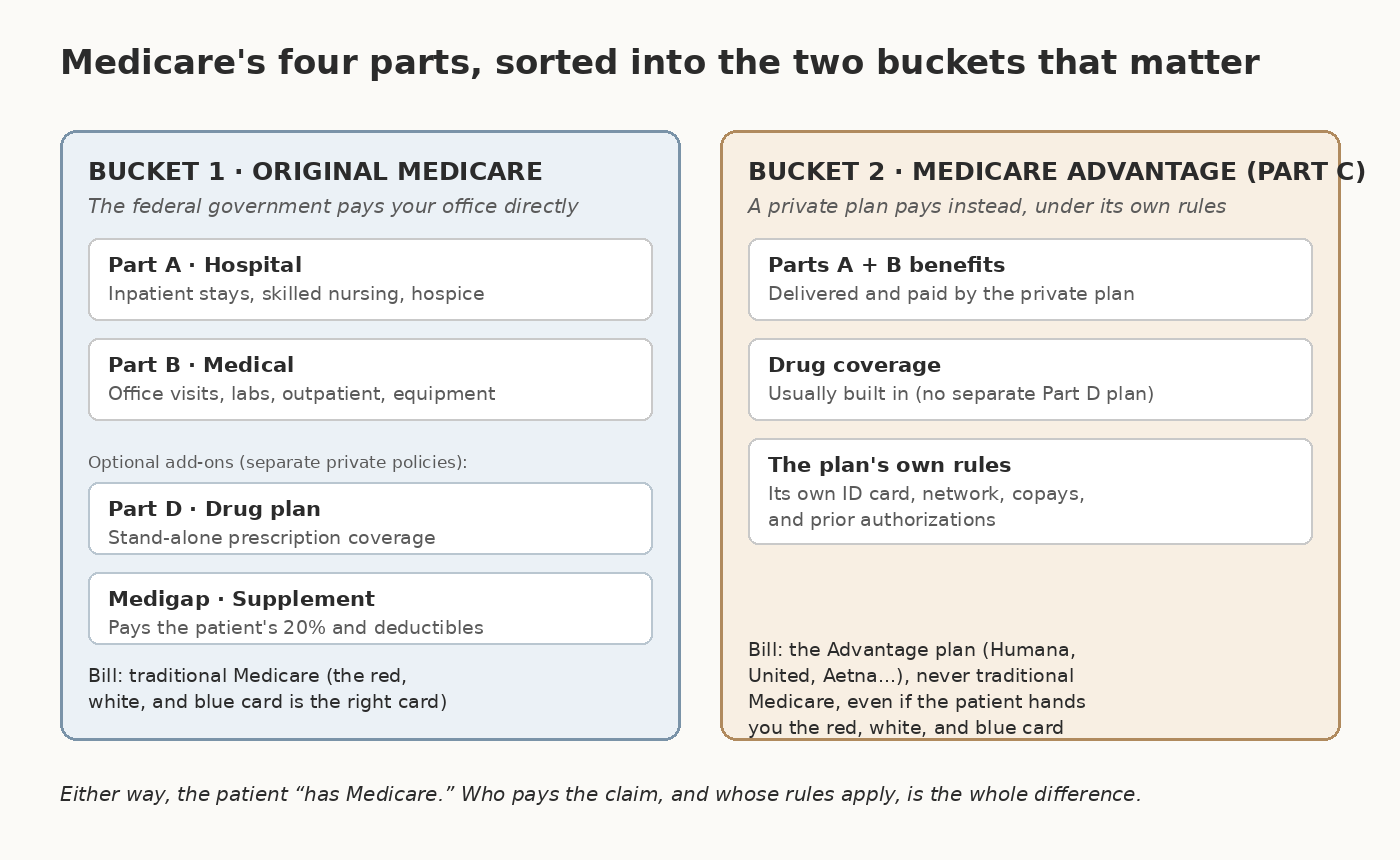
Medicare makes a lot more sense if you sort its four parts into two buckets before you memorize anything. Bucket one is Original Medicare: Part A and Part B, run directly by the federal government. Bucket two is the private layer: Part C, where an insurance company delivers the A and B benefits instead, and Part D, where private plans handle prescriptions. Nearly every confusing thing a patient says at check-in traces back to which bucket they’re standing in.
Plenty of guides explain Medicare to people shopping for it, and Medicare.gov’s overview of the parts does that job well. This one is for people on the other side of the desk. In your first year you don’t need to counsel anyone on plan choices. You do need to read a card, ask the right eligibility question, and understand why a claim went where it went.
One piece of table-setting: who’s on Medicare at all. Mostly people 65 and older, but also younger people who’ve been on Social Security disability for 24 months, people with ALS, and people with end-stage renal disease. So the 40-year-old on your schedule with a Medicare card isn’t a data-entry error.
Part A: hospital insurance
Part A pays for inpatient hospital stays, skilled nursing facility care after a qualifying hospital stay, hospice, and some home health. Roughly 99% of beneficiaries pay no monthly premium for it, because they or a spouse paid Medicare taxes for at least ten years. That’s why older patients talk about having “earned” their Medicare. They’re right.
The quirk worth learning early: Part A’s deductible, $1,736 in 2026, applies per benefit period, not per calendar year. A benefit period starts the day a patient is admitted and ends once they’ve gone 60 straight days without inpatient or skilled nursing care. A patient with a rough year can owe that deductible twice, maybe three times, and a patient who insists they “already met it back in March” can be completely sincere and still wrong. Nobody believes this rule the first time they hear it.
One more trap: a patient can spend a night in a hospital bed without ever being a Part A patient. “Observation status” is outpatient care, billed under Part B, and it doesn’t count toward the three-day inpatient stay that unlocks skilled nursing coverage. Families discover this at the worst possible moment, and the front desk is often where they come to ask why.
Part B: medical insurance
Part B covers the outpatient world: office visits, labs, imaging, ambulance rides, durable medical equipment, preventive care, and, less obviously, drugs a clinician administers. An infusion or an injection given in the office bills under Part B. A prescription the patient fills and takes at home lives under Part D. If you work anywhere near a chemo chair or an allergy practice, that line matters every single day.
Unlike A, Part B always has a monthly premium. The standard rate for 2026 is $202.90, higher at higher incomes; CMS’s 2026 fact sheet has the full tables. After a $283 annual deductible, Medicare pays 80% of the approved amount and the patient owes 20%. Here’s what surprises new staff: under Original Medicare alone, there’s no yearly cap on that 20%. None. A bad diagnosis can generate 20% of a very large number, and that single fact explains most of the second cards in your patients’ wallets.
A quick word on Medigap (which isn’t a part)
Medigap, also sold as Medicare Supplement insurance, is private coverage that pays the patient’s share under Original Medicare: the 20%, the deductibles. It only works alongside A and B, and the policies are standardized by letter, like Plan G or Plan N. Patients say “my supplement” and “my Advantage plan” interchangeably. The two are close to opposites.
Part C: Medicare Advantage, the part everyone confuses
New staff usually assume Part C is extra coverage stacked on top of Medicare. It isn’t. When a patient joins a Medicare Advantage plan, a private insurer (Humana, UnitedHealthcare, Aetna, a regional Blue) takes over delivering their Part A and Part B benefits. The patient is still on Medicare, still typically paying the Part B premium, but the government now pays the plan, and the plan pays you. Its own ID card, its own network, its own prior authorization rules, its own copay structure. Most Advantage plans bundle drug coverage in as well.
The desk-level consequence: the red, white, and blue card in the patient’s wallet is the wrong card. Bill traditional Medicare for a patient who’s actually in an Advantage plan and the claim comes back, while the patient tells you, truthfully, that they handed you their Medicare card. So “Do you have Medicare?” is the wrong intake question. Ask “Do you have a Medicare Advantage plan, like Humana or United?” Patients almost never say “Part C.” They name a carrier, or they say “the one with the gym membership.”
If I could rename one part of Medicare, this is the one. “Advantage” is a marketing word doing exactly what marketing words do: patients hear an upgrade, when the honest description is a trade. Lower premiums and extras like dental, plus an annual out-of-pocket cap that Original Medicare alone never offers, in exchange for networks and prior authorization. More than half of people on Medicare now take that trade, so none of this is an edge case. Some days it’s most of your schedule.
Part D: prescription drug coverage
Part D is drug coverage sold by private plans, either as a stand-alone plan sitting next to Original Medicare or built into an Advantage plan. Every plan has its own formulary and pharmacy network, which is why “my pills were $12 last month and $60 today” is usually a plan question, not a pharmacy mistake.
Two Part D facts reach the clinic side of the desk. First, since 2025 there’s an annual cap on what patients pay out of pocket for covered drugs, set at $2,100 for 2026, which has retired most of the old “donut hole” panic. Second, Medicare charges a lifetime late-enrollment penalty to people who skip Part D when first eligible without other drug coverage. That’s why the patient who takes nothing stronger than a multivitamin still buys a cheap drug plan every year, and if one ever asks you whether that’s silly, it isn’t.
Translating what patients actually say
When a patient says they have “regular Medicare” or “straight Medicare,” expect A and B, probably a stand-alone drug plan, maybe a Medigap card tucked behind the red, white, and blue one. When they name a carrier, or say “Advantage,” you’re in bucket two: bill the plan, follow the plan’s rules, ask about referrals. When they say “supplement,” they mean Original Medicare plus Medigap, even if they call it their Advantage plan two sentences later. Don’t spend energy correcting anyone’s vocabulary. Spend it figuring out which bucket they’re in, because everything downstream, from the copay you collect to where the claim goes, depends on that one answer.